
Use case: Automate a bioassay workflow
For some biological assays, determining relative potency within a single run is not sufficient. In these cases, you perform multiple individual assay runs and then combine the resulting data to obtain a more reliable final potency estimate. The challenge is to combine these individual results efficiently and reproducibly, particularly in regulated environments or when preparing for automated workflows.
Overview
Due to, for example, inherent biological variability or strict precision requirements in regulated environments, a single bioassay run may not provide sufficient statistical power or robustness. By pooling data from several independent runs, it becomes possible to reduce variability, increase confidence in the estimated relative potency, and ensure that the final result meets predefined acceptance criteria.
This use case shows how you can use PLA 3.0 to implement a typical bioassay workflow from entering observation data to calculating results and organizing the full process using a protocol. Learn how to use the document types of the Biological Assay Package to go from individual assay execution to an automated, protocol-driven workflow.
You work with the Quantitative response assay, Combination of assay results, and Basic bioassay protocol document types.
Steps
Automating a basic bioassay workflow comprises the following steps:
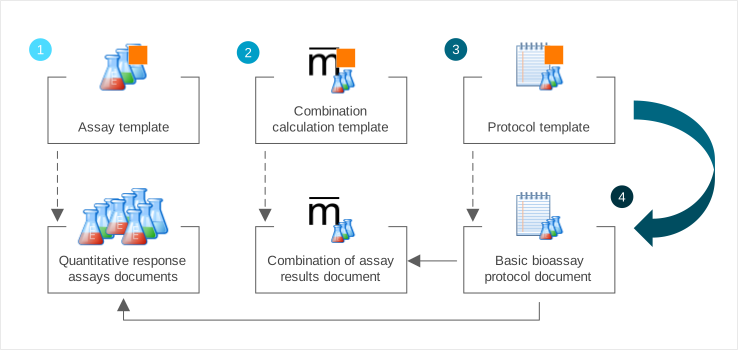
You begin by setting up an assay template that defines the settings you need to design and evaluate your analytical method. Then, you set up a combination calculation template that specifies how PLA 3.0 combines results across multiple assay runs. After that, you set up a protocol template that automates recurring analysis steps and ensures consistency over runs.
Finally, you use these templates to generate a Basic bioassay protocol document that supports routine operation and produces the documents you require as assay data becomes available.