
General tab
Name the configuration profile and define an import strategy.
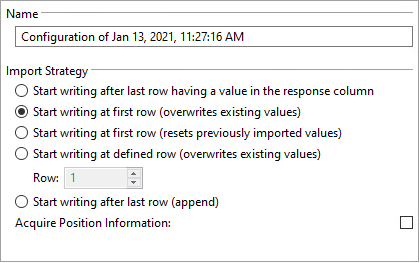
Name
The name of the configuration profile.
Import strategy
When you reacquire the same data or acquire a second dataset, you can use the import strategy to define how existing response values are handled in the data table of the Observations editor.
| Setting | Description |
|---|---|
|
Start writing after last row having a value in the response column |
Starts writing after the last row having a value in the response column. |
|
Start writing at first row (overwrites existing values) |
Starts writing at the first observation row, overwriting existing values. |
|
Start writing at first row (resets previously imported values) |
Starts writing at the first observation row, resetting previously imported values and manually defined technical outliers. |
|
Start writing at defined row (overwrites existing values) |
Starts writing in the specified observation row, overwriting existing values. |
|
Start writing after last row (append) |
Starts writing after the last observation row, keeping existing values. |
|
Acquire position information |
Generates row, column, and plate factor values if available. Important:
This setting is not yet available for all
data acquisition modules. |
Example of an import strategy
| Import strategy | No response values | Last row with response value: 16 | Last row with response value: 8 | Is the existing dataset deleted? |
|---|---|---|---|---|
|
Start writing after last row having a value in the response column |
1 |
17 |
9 |
No |
|
Start writing at first row (overwrites existing values) |
1 |
1 |
1 |
No |
|
Start writing at first row (resets previously imported values) |
1 |
1 |
1 |
Yes |
|
Start writing at defined row (overwrites existing values) |
N |
N |
N |
No |
|
Start writing after last row (append) |
17 |
17 |
17 |
No |